
Merino wool or synthetics? It sounds like a matter of taste, but the answer comes down to very concrete things: how much you move, how many hours you spend outdoors, whether you can wash every evening and how much you pay for a set.
The short version: if you move a lot, get up early and throw the set in the washing machine every evening, go for synthetics: they are cheaper, dry faster and take more abrasion. If you spend long days outdoors without moving much, or travel for several days without a washing machine, merino wool pays off with freshness and warmth even when damp. For your feet merino wins almost every time; for the torso, synthetics are enough for most anglers and ATV riders in the Baltic states.
What a base layer actually does
A base layer does not keep you warm. Its job is to move sweat away from your skin so you don't start freezing once you stop. Warmth is the job of the second layer, and protection from wind and water belongs to the third. So the question “merino or synthetics” is really the question “which one handles my sweat better at the pace I move”.
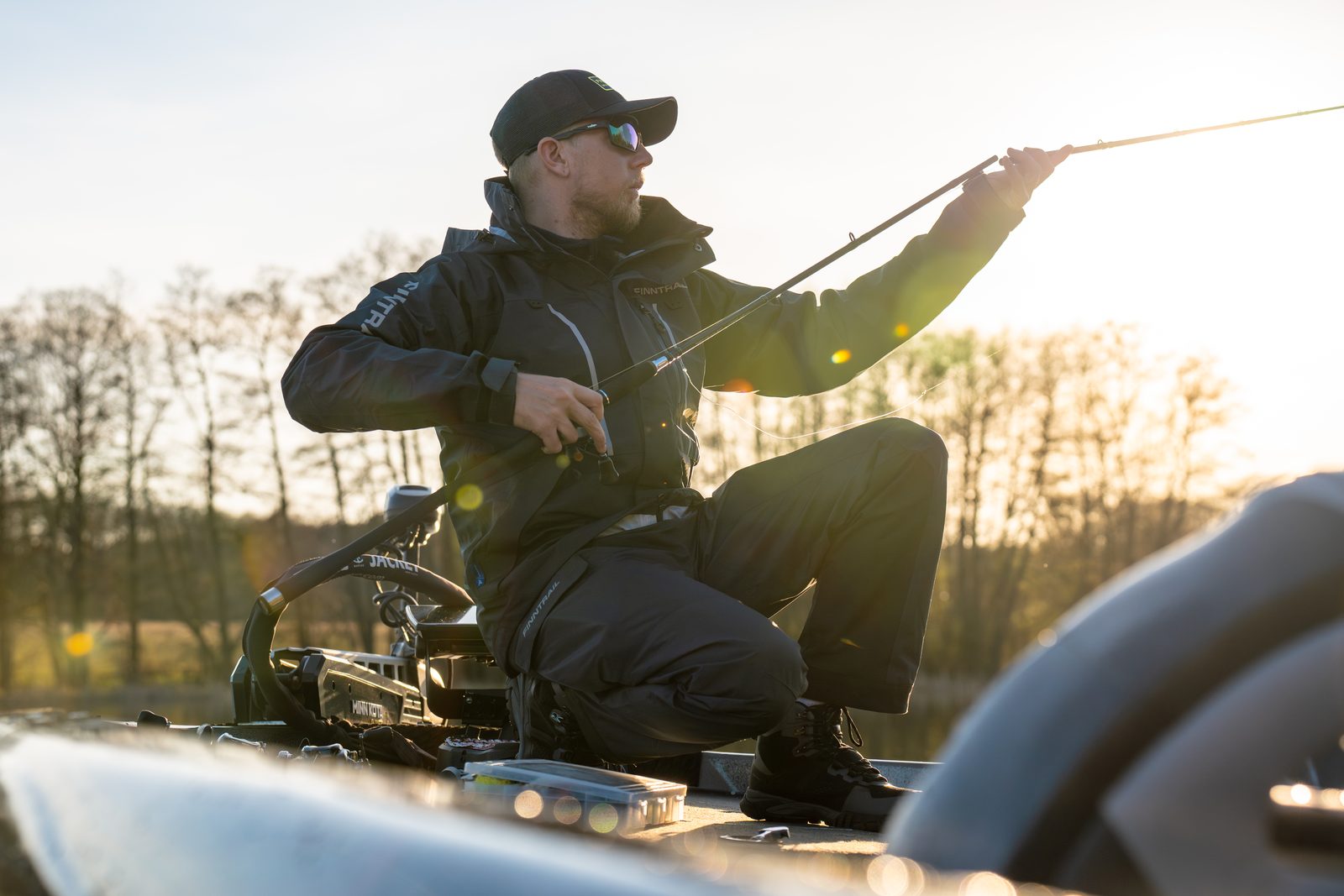
What never works is cotton. It soaks up moisture and holds it against your skin, so a wet cotton T-shirt under your waders chills you even when your outer layers are flawless. The rest of this article is about the two sensible choices and leaves cotton at home.
If the layering system is not clear yet, start with the guide on how to layer your clothing in every season, then come back here to pick your base layer.
Merino wool: where it really is better
Merino is not the wool you remember from a childhood sweater. The fibre is about three times thinner than a human hair, so it doesn't itch. All of its practical properties come from that fineness.
- Warm even when damp. Merino absorbs up to 30% of its own weight in moisture and still feels dry. Where synthetics already feel cold and clammy, wool keeps working.
- Hardly any odour. Wool fibre traps odour molecules and releases them only in the wash. In practice you can wear a base layer for three or four days and socks for two or three.
- Regulates temperature on its own. Air pockets between the fibres keep you warm without overheating, so one set feels comfortable both on the move and while waiting for a bite.
- Kind to sensitive skin. Our merino set is OEKO-TEX certified and hypoallergenic, which matters when a layer touches your skin all day.
The weaknesses are real too: merino costs more, dries slower and wears out faster where backpack straps or the wader socks rub.
Synthetics: where they win
Synthetic thermal underwear is polyester, often with polyamide and elastane or with a microfleece lining. It doesn't try to be natural; it tries to move moisture away from your skin as fast as possible.
- Dry overnight. Wash it at camp in the evening and put it on in the morning. Merino doesn't dry at that pace.
- Take more punishment. Elastane brings back the shape and the fibre doesn't mind abrasion, so the set stays close-fitting after dozens of washes.
- Cost less. A full synthetic set starts at 69 €, while the merino set costs 139 €.
- Stretch with you. Fit matters: a base layer that is too loose won't move moisture, while fabric with elastane fits close without squeezing.
The weakness is single and well known: odour. After two intense days synthetics need a wash, and no tricks help with that.
Table: merino vs synthetics
| What you expect | Merino wool | Synthetics |
|---|---|---|
| Warmth when damp | Retained | Drops faster |
| Odour after a few days | Almost none | Appears quickly |
| Drying speed | Slow | Fast |
| Abrasion resistance | Medium | Good |
| Price per set | From 139 € | From 69 € |
| Care | Wool cycle, dry flat | 30 °C, as usual |
| When to choose | Long quiet days, several days without a washing machine | Active pace, frequent washing, limited budget |
How to choose based on what you do
Instead of comparing fibres in the abstract, find yourself in one of four situations.
- Ice fishing in winter, lots of sitting. Warmth at rest wins here. Take a warmer base layer and merino socks: Finntrail TACTIC 6307 covers +10 °C to −25 °C, and EXTREME MERINO 3203 are the warmest socks in the range.
- River, wading, constant movement. You sweat a lot, so speed matters most. Go for THERMO S 6304 with a microfleece lining or ALLSEASON 6208, whose +15 °C to −15 °C range is the widest in our catalogue.
- Several days without a washing machine. A trip, a hunting camp, a long ATV route. Then the benefit of merino is not theoretical: the MERINO 6209 set and MERINO LONG 3206 socks let you wear the same pieces for several days.
- Cool but not cold season. September and May. You don't need full thermals yet; thin synthetic COOLMAX 3202 socks and a light base layer are enough.
You'll find the full base layer selection in the catalogue, and warmth comes from the second layer: for example POLAR 1400 thermal trousers or the POLAR JACKET 1391 fleece.
When it doesn't fit
It's only fair to say what neither option will do.
- Merino is not for you if you don't like careful washing. Hot water and a normal spin cycle felt the fibre for good, and the warranty doesn't cover wool damaged that way.
- Merino doesn't suit places with heavy rubbing. Heavy backpack straps, long hours in the saddle and the wader socks wear it out faster than synthetics.
- Synthetics don't suit a multi-day trip without a washing machine. By day three the odour question outweighs every other advantage.
- No base layer will replace a second layer. If you're cold, what's missing is not different underwear but an insulating layer on top of it.
- A loose set doesn't work. If you're between two sizes, take the smaller one: the fabric has to touch your skin.
Care differs more than the fabric itself
Most thermal clothing is ruined not outdoors but in the washing machine.
- Water up to 30 °C, wool or delicate cycle. Hot water shrinks merino for good.
- Spin at 400 to 600 rpm. A faster spin felts the fibre.
- No fabric softener. It coats the fibre and the underwear stops moving moisture. This applies to both materials.
- Enzyme-free detergent. For wool use Mountval Wool Wash, and you'll find the full range of care products in the catalogue.
- Dry flat, not hanging. Wet wool is heavy and stretches when hung. It dries in 12 to 24 hours.
- Hang it to air out between wears. That is often enough instead of washing, especially for merino.
How often to wash: a merino base layer after three or four active days, merino socks after two or three, synthetics after every intense day.
Frequently asked questions
In dry conditions the difference is small; thickness decides everything. The gap opens when the layer gets damp: merino still keeps you warm, while synthetics lose heat faster.
No. A base layer only works when it sits right against your skin. A T-shirt underneath traps moisture and ruins the whole system.
For the feet merino usually wins: feet sweat, and moisture stays in the boot for a long time. For the cold season pick EXTREME MERINO 3203, for cool days MERINO LONG 3206 from +5 °C to −15 °C, and for a warm day there are synthetic COOLMAX 3202.
No, it's a different trade-off. From 80% merino, a garment is cared for like pure wool, and the more synthetic fibre it has, the more abrasion-resistant it is and the faster it dries.
For one set for the whole season, pick synthetics with a wide temperature range, for example ALLSEASON 6208, and add merino socks. That combo gives you the most benefit for the least money.
What we have in the catalogue
Three synthetic sets and one merino, plus socks for both sides.
- THERMO S 6304, 69 €: polyester with a microfleece lining, +10 °C to −25 °C.
- ALLSEASON 6208, 74 €: polyester, polyamide and elastane, the widest range from +15 °C to −15 °C.
- TACTIC 6307, 89 €: for long days outdoors, seven sizes.
- MERINO 6209, 139 €: 100% merino wool, OEKO-TEX. It's the only merino base layer in the catalogue, so check that your size is still available before you plan.
- Socks: EXTREME MERINO 3203 29 €, MERINO LONG 3206 14 €, COOLMAX 3202 15 €.
Prices and remaining sizes are always shown on the product page. When the temperature drops below what a base layer covers, read on about which clothes work in cold weather and winter.

